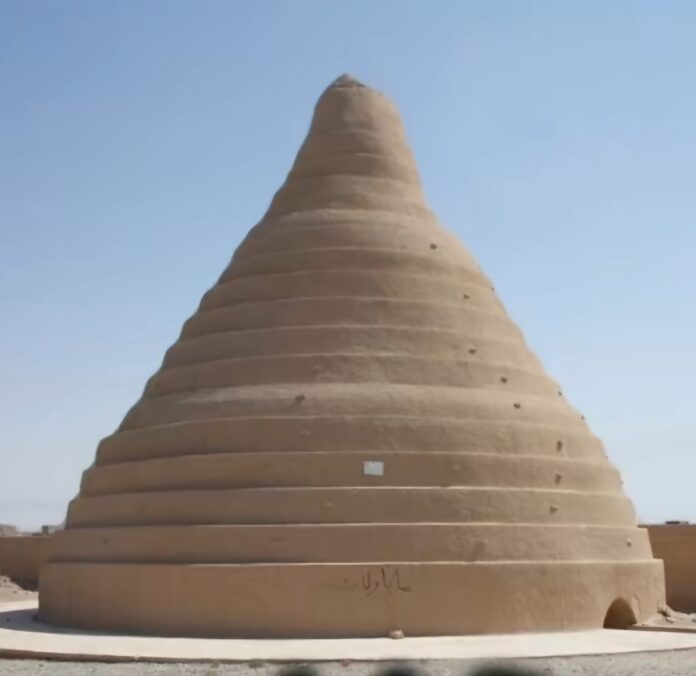

Yakhchal: The Ancient Refrigerator That Preserved Ice in the Desert
While I was writing about the ancient windcatchers (badgirs) used to cool houses in scorching deserts, a question suddenly struck me:
“If they had natural air conditioners, did they also have ice?”
At first, it seemed impossible. How could ice exist in the middle of burning deserts? But my curiosity led me to a fascinating discovery: the Yakhchal, meaning “Ice Pit” in Persian. This giant mud-brick structure enabled people to store ice for an entire year—without electricity.
—
A Glimpse Into History
The Yakhchal was first developed by the ancient Persians more than 2,400 years ago, during the Achaemenid Empire (around 400 BCE).
These structures spread widely in Iran, especially in desert cities like Yazd and Kerman, and even influenced neighboring regions.
For ordinary people, the Yakhchal was a community refrigerator: ice was collected during the winter or produced at night, then stored deep inside the structure. In summer, it was distributed to households, markets, and even royal palaces.
—
How Did the Yakhchal Work?
The Yakhchal was far more than a mud dome—it was a masterpiece of passive engineering based entirely on natural physics.


1. Water Channels (Qanats)
Built near underground water canals, the Yakhchal diverted water into shallow surface pools next to the structure.


2. Nighttime Freezing
In deserts, days are blistering hot but nights can be freezing cold. Thanks to radiative cooling—where surfaces release heat into the open night sky—the thin layers of water in the shallow pools would freeze overnight.


3. Collecting the Ice
At dawn, frozen sheets of ice were gathered and carried into a deep conical pit inside the Yakhchal, where they were stacked layer by layer.

4. Air Circulation
Cold, dense air entered through the lower vent.
Warm, lighter air escaped through the top vent.
This natural airflow created a constant cycle of cooling.

5. Insulating Walls
The dome’s walls were up to two meters thick, made of sarooj—a special mix of clay, sand, lime, ash, goat hair, and egg whites. This waterproof and heat-resistant material locked in the coolness and prevented melting.
—
A Human Touch: My Personal Fascination
When I discovered the Yakhchal, I couldn’t help but feel a mix of awe—and even envy—towards our ancestors.
Today, when electricity cuts off, I struggle to find ice and often have to buy it. Yet thousands of years ago, people in the desert had already solved this problem brilliantly, using nothing but natural physics.
This made me rethink the meaning of the word “Jahiliyyah” (the so-called “Age of Ignorance”). These people weren’t ignorant at all—they were ingenious, turning the harsh desert into a place where even ice could be preserved.
—
Everyday Uses of the Yakhchal
Cooling drinking water.
Making refreshing drinks in summer.
Preserving food for longer periods.
Supplying ice to nobles and kings as a symbol of luxury.
Ice was more than comfort—it was prestige. The ability to store and serve it showed civilization, wealth, and power.
—
The Yakhchal in Modern Times
Although refrigerators eventually replaced them, many Yakhchals still stand today in Iranian deserts as reminders of this ancient ingenuity.
Architects and environmental engineers now study these structures as models of sustainable design, inspiring green architecture that relies less on electricity and more on natural climate control.
—
Conclusion
The Yakhchal is proof that ancient people were not just survivors, but scientists in their own right.
With nothing but clay, water, and the laws of physics, they preserved ice for a whole year in one of the hottest climates on Earth.
This is more than an architectural wonder—it’s a lesson for our modern world: intelligence doesn’t always mean advanced technology; sometimes it’s about observing nature and working with it, not against it.
✍️ Article by Knowledge Corner
—