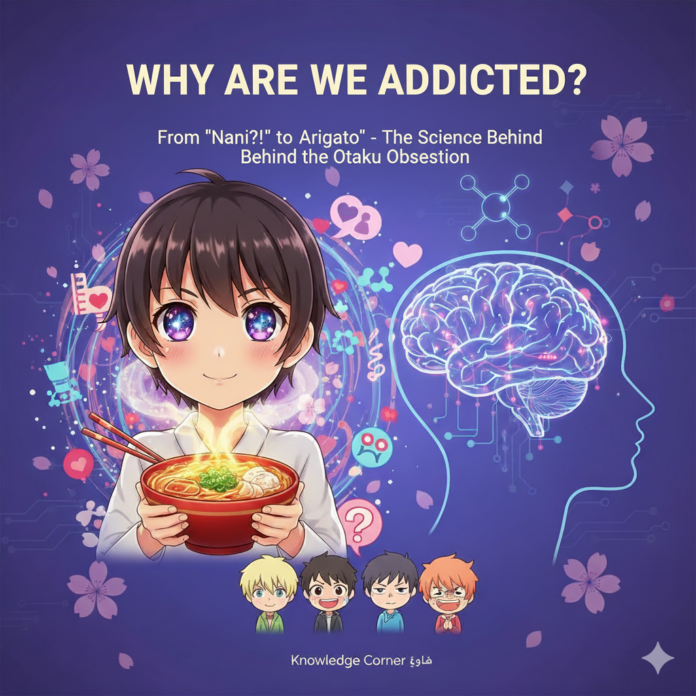

Why We Get Addicted to Anime — From “Nani?!” to “Arigatō”

We all have that friend: half of their life on their bed clutching a phone or laptop, the other half living inside a colorful world of characters with impossible hair.
If you look at their social account, their username might be written in Japanese — Sasuke-kun or Rina-chan — and their avatar isn’t a real photo but an anime face looking off into the horizon.
When they speak you’ll sometimes hear them suddenly say “Nani?!” (What?!), “Baka!” (You idiot!), or “Arigatō!” (Thank you!).
You smile and wonder: why are they so into this? What is it about anime that hooks them so hard? Why do they grow emotionally attached to drawn characters, and why does it become, for some, an addiction?
Yes — addiction. Not because they’re weak or crazy, but because anime is crafted in a way that directly engages the brain and emotions. We’ll unpack that together. Strap in — we’ll travel through history, psychology, and feeling into the world of otaku.
—

The Origins: How It All Began
The word anime comes from “animation,” but the Japanese didn’t leave it at that — they turned it into a distinct art form reflecting their culture.
The earliest prototype of anime was discovered (oddly) in 2005: a tiny 33-second film from 1907 called Katsudō Shashin.
Later, in 1917, the first real anime we can point to appeared: Jun’ichi Kōuchi’s Namakura Gatana (“The Dull Sword”).

During World War II, anime became a propaganda weapon — Japan used animation to depict enemies as monstrous. The Allies used cartoons to mock Japan and the Axis. It was a cartoon front of the war.
After the war, anime softened and transformed into something much kinder: stories of peace and imagination.
—

The Big Eyes — The Magic of Emotion
To understand addiction, we must start with anime’s most distinctive trait: huge eyes.
In the 1950s, manga artist Osamu Tezuka drew characters (notably Astro Boy) with oversized expressive eyes, inspired by early Disney films. Tezuka believed large eyes express stronger emotions — and he was right.
Japanese culture tends to be emotionally restrained. People often don’t vocalize hunger, tiredness, or sadness. Over time the Japanese learned to “read eyes.” Big, shining eyes on screen became a substitute for spoken feeling — a direct emotional channel.
Those eyes made a strong emotional connection between viewer and character.
But then came exaggeration.
Big eyes, tiny noses, adorable proportions — all of these exploit human wiring. Our brains are programmed to respond to childlike facial features (they trigger nurturing instincts), so anime characters designed this way become instantly lovable.
That’s deliberate: creators want you to bond with their characters.
Note: villains often have smaller, harsher eyes. (Remember Death Note? Light’s eyes looked smaller and more intense when he was corrupt; when his memory was wiped his eyes seemed larger and more innocent — even the animators play with this trick!)
—

Exaggeration Everywhere
Nothing in anime is “normal.” Food is shinier and more delicious-looking than in real life; fights violate physics; emotions hit like tidal waves.
I remember trying to pull off a Kamehameha after watching Dragon Ball — the only thing I managed to destroy was a chair. Still, that’s the point: anime is not just watched; it’s experienced.
Even food scenes make you crave dishes you never knew existed — ramen always looks impossible to resist. My friends and I used to joke, “Anime is our world and ramen is our food.” 🍜🫣
Romance is exaggerated too. Some anime, labeled shōjo, are aimed at teenage girls and overflow with amplified feelings. Shōnen anime, aimed more at boys, deliver friendship, heroism, and battle. These emotional surges release dopamine — the brain’s reward chemical — and it’s easy to get hooked: once you taste that peak, ordinary life can feel bland, like comparing a jar of Nutella to an apple.
—

UwU and the Cult of Cuteness
If you’ve spent time online you’ve seen UwU. Pronounced like “oo-woo,” it’s a face/sound shorthand for extreme cuteness and baby-ish playfulness. It emerged around 2004 on certain websites and became a meme of forced cuteness imitation. (There are even Wikipedia pages about it — I tried reading one and felt a little headache from all this Pretend .)
—

The Dark Side: When Cuteness Becomes Isolation
Not everything sparkles. Japan has seen real, worrying effects: Hikikomori — people (often young) who withdraw entirely and shut themselves in their rooms for months or years. Over time such isolation can turn into kodokushi (“lonely death”), where someone dies at home and isn’t discovered for months.
There’s also Japanophilia — an obsessive love of Japanese culture that can slide into weeaboo behavior, where someone tries to adopt Japanese identity wholesale.
A chilling extreme: the case of Tsutomu Miyazaki, the so-called “Otaku murderer,” who committed horrific crimes. He claimed an anime character called “Rat Man” told him to kill; when police searched his home they found walls full of manga, tapes, and posters — a total withdrawal into a fictional world. That tragedy forced Japanese society to seriously examine the boundaries between fandom and dangerous detachment.
—

How “Otaku” Got Its Name
The term otaku first appears (as a derogatory term) in the 1983 manga Burikko by Akio Nakamori. It described socially withdrawn people obsessed with media. Over time fans reclaimed the label proudly: “Yes, we are otaku — people who live stories passionately.”
—

Anime as High Art
Anime isn’t only escapism. Some works are deeply artistic and philosophical.
Director Hayao Miyazaki created films like
( Future Boy Conan )that blend fantasy with moral messages about the environment, human dignity, and ethics. Grave of the Fireflies (from the 1980s) is a devastating anti-war masterpiece. Modern shows like Attack on Titan or Death Parade wrestle with morality, freedom, and death.
(It was great, I recommend it.🤣🍜 )
—

Otaku Culture Through Psychology
Psychologist Abraham Maslow’s famed hierarchy includes belonging as a core need. Anime fandom provides that belonging: global communities where people “get” you.
When I first watched anime it was casual. But when I found groups discussing the same scenes and theories, I felt seen. That sense of being understood — the belonging — is what makes the culture powerful. It’s not necessarily loneliness; it’s the human longing for connection.

—

Final Check — Reality Matters
Not every otaku is isolated or detached. Many are artists, thoughtful people, or creatives. The trouble comes when anime becomes a substitute for life rather than a complement.
Anime is like sushi: delicious and wonderful, but not something to live on every day. Enjoy it. Learn from it. Let it enrich your imagination. But remember to step outside, breathe real air, and live your own story — because the real world also holds beautiful arcs, and you are the main character there too.
✍️ Written by: Knowledge Corner