
What If Everyone Became Rich?
From Utopia to Collapse — The Terrifying Lessons of “Universe 25”
Have you ever wondered, dear reader, what would happen if everyone suddenly became rich?
No debts. No stress. No hunger. A world where everything is abundant, comfortable, and effortless.
Would life turn into paradise—or would we discover that a life without struggle isn’t heaven at all?
Think about it: why does Elon Musk, worth over $220 billion, still work tirelessly in his fifties?
If he spent even $1 billion every year, he’d still have more money than his great-great-grandchildren could spend.
So why keep working instead of traveling the world and living in luxury?
The answer, oddly enough, lies in a mouse cage.
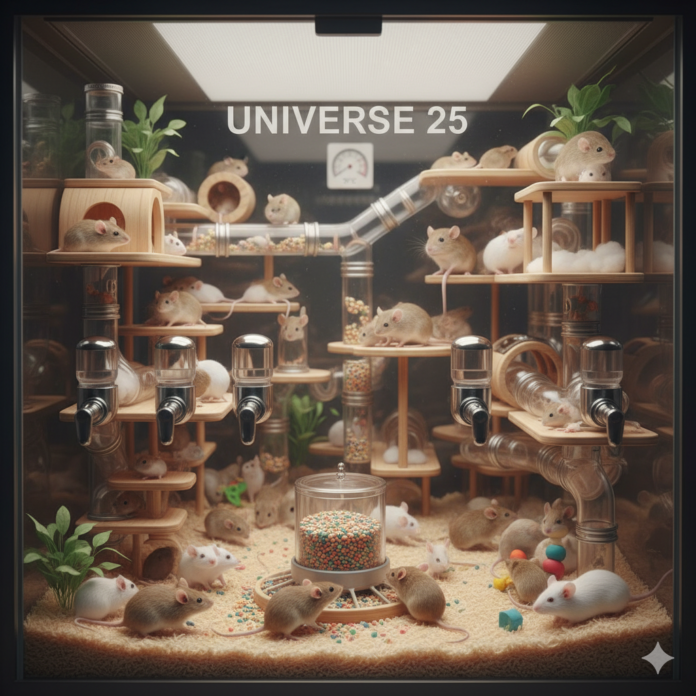
Yes, you read that right. In the 1960s, American behavioral researcher John B. Calhoun ran a terrifyingly insightful experiment called “Universe 25.”
His goal was to create a perfect world for mice — a rodent utopia — and see what would happen when all needs were met without effort.
The result? A paradise that slowly turned into a nightmare.
—

The Beginning: Building Paradise for Mice
In the late 1940s, Calhoun became fascinated with animal behavior, especially mice — creatures that, socially, aren’t too different from us.
They live in communities, form hierarchies, compete, and nurture their young.
So he asked a simple but dangerous question: What happens when every need is satisfied?
He designed a massive enclosure, stocked it with unlimited food, clean filtered water, and maintained the perfect temperature (20°C).
He ensured total safety from predators and disease — a flawless world.
He called it “Mouse Utopia.”
(And honestly, dear reader, for a moment I almost envied them. A paradise with free food and no responsibilities? Sign me up! 🤣)

He began with just eight healthy mice — four males and four females.
Within weeks, their population exploded: 8 became 620, then 1,000, then nearly 2,200 mice.
But then, something strange happened.
Even though there was still plenty of food, the growth rate slowed… and then began to collapse.
—

When Comfort Becomes the Enemy
Despite the abundance, chaos began to creep in.
Older mice claimed the best spots — the “VIP corners” near food and water.
The younger generation didn’t like that, so they fought back violently.
Little by little, society in the cage began to fracture into classes and gangs, much like human society:
The elites, the mid-level groups, and the outcasts.

Weaker mice stopped resisting and began lashing out at those below them.
Aggression spread like a virus.
Females turned violent toward their own offspring, sometimes even killing or eating them.
Infant mortality rose to 90%.
Calhoun called this the “First Death” — the death of society.
What came next was even darker — the “Second Death” — the death of purpose.
The next generation of mice, born after the chaos, had never experienced danger or scarcity.
They didn’t care to mate, explore, or build.
They simply ate, slept, and groomed themselves — endlessly, meaninglessly.
They became passive, fearful, and isolated.
Eventually, the entire colony went extinct… surrounded by food and comfort.
They died in paradise.
—

What Can This Tell Us About Humans?
Calhoun concluded:
> “When every need is easily met, purpose disappears — and the species declines.”
But can we really compare mice to humans?
Yes and no.
Humans are far more complex — we have creativity, culture, empathy, and intellect.
Yet, the patterns of motivation and boredom born from excess are eerily similar.
Modern societies with extreme wealth often face high rates of depression, isolation, and anxiety — not because of poverty, but because of comfort.
We’re built to strive, not to stagnate.
—

Why Do Billionaires Keep Working?
Now it makes sense, doesn’t it?
A living being — whether a mouse or a human — needs challenge to feel alive.
When survival is guaranteed, the mind creates new challenges — projects, risks, goals, rivalries — anything to awaken meaning again.
Elon Musk doesn’t work for money; he works to fight boredom with ambition.
Even world-class athletes, already millionaires, still cry when they lose and cheer wildly when they score.
Because glory can’t be bought — it must be earned.
Without challenge, even paradise becomes prison.
—

The Science Behind It: Why We Crave Struggle
Our brains are wired for dopamine — the “reward chemical.”
When we overcome obstacles, dopamine rewards us with joy and motivation.
But when everything comes too easily, that reward system shuts down.
Pleasure fades. Motivation dies.
And comfort becomes suffocating.
Ironically, a little struggle is essential to mental health.
Like muscles that need resistance to grow, the human spirit needs effort and adversity to stay alive.
Work, study, creativity, and even stress — they’re not just burdens. They’re the reasons we keep going.
—

The Criticism: Humans Aren’t Mice
Modern scientists have criticized Calhoun’s conclusions.
Mice lack art, empathy, and purpose beyond instinct.
Humans can adapt, cooperate, and change their environments.
What Calhoun called “social death” isn’t biological death — it’s the death of connection and meaning.
Still, the experiment remains a haunting metaphor.
It warns us that comfort without purpose leads to quiet extinction — not of the body, but of the soul.
—

The Final Lesson: We Live for the Climb
In the end, perhaps those mice were just mirrors reflecting a simplified version of us.
But unlike them, we have imagination — the ability to create meaning where none exists.
So if you ever feel empty, lost, or unmotivated,
don’t say “I need more money.”
Say: “I need a new challenge.”
Find something worth chasing — a project, a dream, a purpose.
Not because you’re poor, but because you’re human.
True wealth isn’t measured by what you have,
but by how much meaning you’re still searching for. 🌍✨
—
✍️ By Knowledge Corner