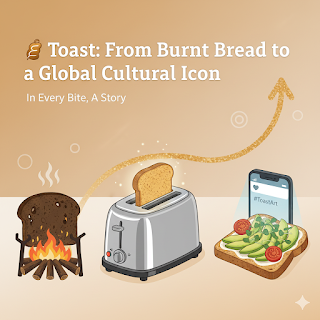
🥖 Toast: From Burnt Bread to a Global Cultural Icon

Introduction: How Did Toast Evolve from “Leftover Bread” to an Instagram Symbol?

In the corners of our kitchens—between the hum of the toaster and the occasional scent of burnt bread—lies an untold story.
It’s the story of toast, that golden, crunchy creation found on breakfast tables across the world, served in both the finest restaurants and the humblest cafés.
But here’s the question: how did toast evolve from a simple method to preserve bread into a cultural phenomenon worthy of an Instagram post?

Humble Beginnings: An Invention Born of Necessity, Not Luxury
Before it became a symbol of taste and style, toast was born out of necessity.
In the pre-refrigeration era, toasting was a clever way to extend a loaf’s lifespan and prevent mold.
During the Middle Ages, toasted bread was a meal for the poor — soaked in broth or wine to become filling and affordable.
In that sense, toast embodied an early version of food recycling centuries before the concept became fashionable.
It was the practical expression of an old saying: “Don’t throw away stale bread — toast it.”

The Toaster Revolution: From Coal and Fire to Modern Convenience
The year 1913 marked a turning point with the invention of the first safe electric toaster by the American company “Copeman Electric Stove.”
No longer tied to coal and smoke, toast entered the modern kitchen as a symbol of progress and innovation.
Owning a toaster became, at the time, what owning a smartphone is today — a sign of being up-to-date with the modern world.
Toast had transformed from a symbol of poverty to a marker of comfort and modern living, and became a ritual announcing the start of a new day.
–

The Decorated Toast Era: When Food Became Identity
In the past decade, a quiet revolution began.
What started as a simple avocado toast trend on Instagram quickly grew into a full-fledged cultural movement.
Toast was no longer just food — it became a canvas for self-expression and identity:
🥑 Avocado toast on sourdough signals health consciousness and eco-awareness.
🍓 Brioche toast topped with strawberries and cream represents luxury and refined taste.
🌾 Whole-grain toast with chia seeds speaks of fitness and mindful eating.
In this evolution, a single slice of toast became a miniature piece of art — a visual language revealing who we are and what we value.
> From #AvocadoToast to #ToastArt, the humble slice has become a social statement in the digital age.

Why We Love Toast: The Comfort of Simplicity in a Complex World
Amid the fast-paced chaos of modern life, toast remains a comforting constant.
It’s the quintessential comfort food, taking us back to childhood mornings when our biggest concern was whether to spread jam or honey.
Toast is deeply democratic — it belongs to everyone, across classes and cultures.
It bridges past and present, simplicity and sophistication, memory and creativity.

Conclusion: In Every Bite, a Story
Next time you bite into a piece of toast, remember: you’re not just tasting bread.
You’re tasting a history of human ingenuity, social change, and nostalgia.
From the ovens of ancient Rome to the feeds of Instagram influencers, toast has witnessed humanity’s journey — from scarcity to abundance, from survival to self-expression.
> In the end, toast reminds us that the greatest transformations often begin with the simplest things.
Who
would have imagined that a humble slice of bread could carry so many stories?