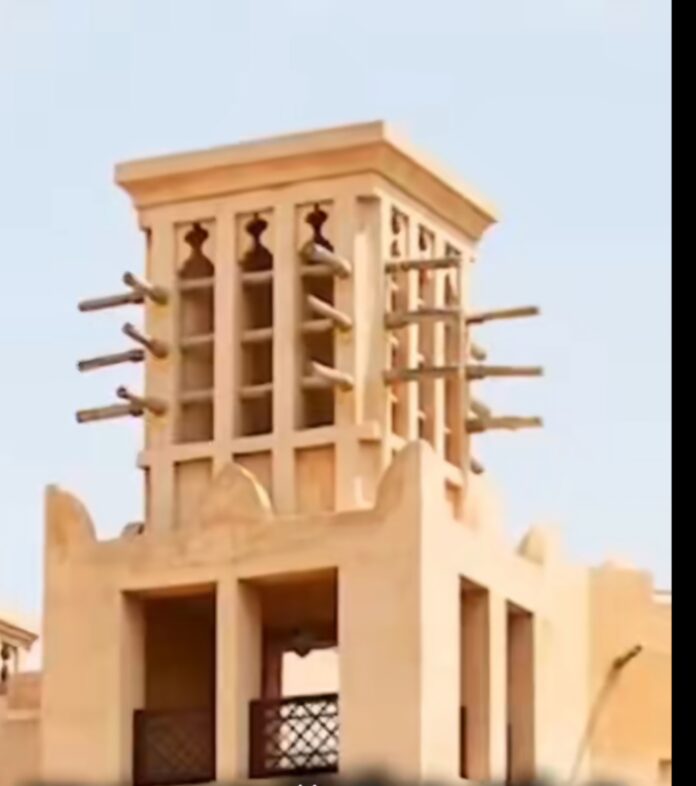
The Wind Catcher: An Ancient
Innovation Ahead of Its Time

Thousands of years ago, in the scorching deserts where the sun showed no mercy, humans came up with ingenious solutions to beat the heat. Among the most remarkable of these was the wind catcher, known in Persian as the “Badgir.” This architectural marvel transformed homes, palaces, and public buildings into naturally cooled spaces, long before electricity or modern air conditioning existed. Historians still admire this brilliant innovation that blended simplicity with science.
—
What is a Wind Catcher?
A wind catcher is a tall tower built above houses or public structures, with carefully oriented openings that face prevailing winds. As the wind enters through these openings, it is funneled down into the interior spaces, spreading cool air throughout the building. This simple yet powerful design made it one of the earliest forms of passive cooling systems in human history.

—
How Does It Work Scientifically?
1. Wind Direction: The tower’s openings are positioned to capture the region’s dominant winds.
2. Air Pressure and Density: When cool air enters, it sinks downward due to its higher density, forcing the warmer indoor air to rise and escape through a dome vent or ceiling openings. (This explains why domes were so common in traditional architecture.)
3. Evaporative Cooling: In some cases, water basins were placed at the base of the tower. As air passed over the water, it cooled further before entering the living space.
💡 Continuous Cooling Cycle:
The system works as a never-ending cycle. Fresh cool air keeps entering through the tower, while warmer air is constantly pushed out through the dome vents. Even though the cool air eventually heats up, it is quickly replaced by new air, ensuring ongoing ventilation. Interestingly, wind catchers are often more effective at night, since they trap and store cool nighttime air, keeping homes comfortable well into the day.


—
Historical Roots
Pre-Islamic Arabia: In the Arabian Peninsula, especially in the Hijaz and Yemen, wind catchers were integrated into stone and mud-brick houses to combat intense heat and humidity.
Persians and Babylonians: Ancient inscriptions show that Persians perfected the design, particularly in desert cities like Yazd, where many wind catchers still stand today as cultural and architectural heritage.
Ancient Egyptians: Evidence from papyri and temple drawings indicates the use of similar ventilation methods, proving how deeply this concept was embedded in their architecture.
Clearly, wind catchers were not limited to one culture—they were a shared human legacy of ingenuity.

—
Human Touch: More Than Just Architecture
Picture a family living in the desert: children playing in a shaded courtyard while a gentle breeze flows down from the wind catcher, cooling the home and bringing relief from the burning sun. This was not just an architectural device—it was a human refuge. It created comfort, preserved dignity, and gave people a sense of mastery over their harsh environment.
—
Wind Catchers in the Modern Era
While air conditioners dominate today’s world, modern architects are revisiting the wind catcher as a sustainable, eco-friendly solution. It requires no electricity, operates purely on natural physics, and reduces environmental impact. For this reason, wind catchers are being reintroduced in “green buildings” as symbols of human intelligence in harmony with nature.
—
Conclusion
The wind catcher is a timeless reminder that people in so-called “primitive” times were far from ignorant. With limited tools, they engineered systems of physics, architecture, and humanity all in one. What started as a clay-and-stone tower in the deserts thousands of years ago continues to inspire modern design today, proving that innovation knows no era.
✍️ Written by: Knowledge Corner