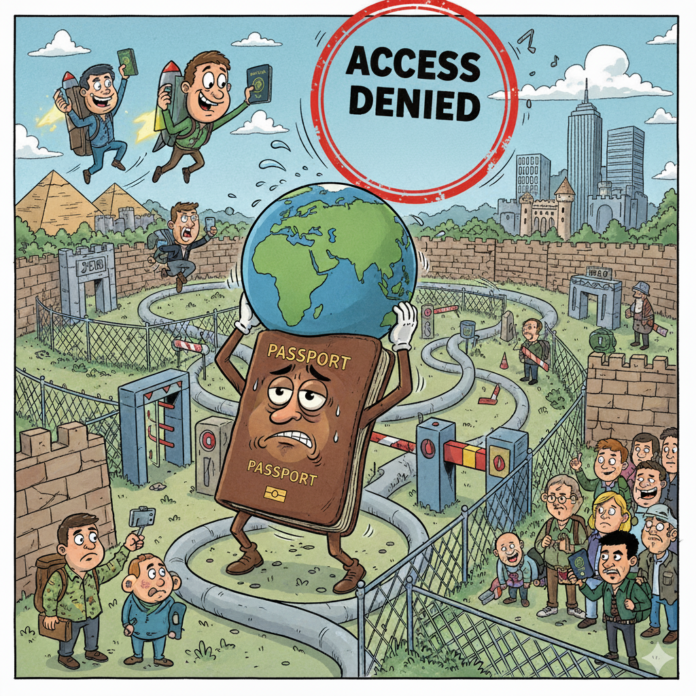

The Passport: The Strange Little Book That Decides Your Fate
Imagine this, dear reader:
You’re sitting at your desk, dreaming big — planning to launch your own business abroad,
or maybe move to another country to start fresh,
or even travel the world creating content about its hidden wonders.
You plan, you dream, you visualize everything in detail…
until reality hits you like airport security:
your passport says “Access Denied.”
Yes — that cheap little booklet, with its fancy cover and tired pages,
has just decided that your dreams have borders.
Why does this tiny paper gatekeeper hold so much power?
Who invented it? And why do some people get to pass freely while others get stopped at every door?
Fasten your seatbelt, because today we’re traveling — visa-free —
through the fascinating (and sometimes frustrating) history of the passport.
—

🏺 Ancient Beginnings: The First “Travel Permit”
Our story begins more than 2,400 years ago with King Artaxerxes I of Persia
and his trusted servant Nehemiah, whose story is even mentioned in the Bible.
Nehemiah asked the king for a letter — an official document proving he came in peace
and granting him safe passage through foreign lands.
The king agreed, and that letter became one of the earliest travel documents in human history.
No stamps, no visas, no awkward border interviews —
just royal words that opened every gate.
(If only travel were still that simple today 😅).
—

📜 Passports in the Islamic Golden Age
Fast-forward to the eighth century.
The Austrian scholar Adolf Grohmann, in his book Arabic Papyri,
mentions one of the oldest known Arabic travel permits —
a document issued in the year 116 AH (around 734 CE)
by Abdullah ibn Ubayd, the governor of Egypt under the Umayyad Empire.
It described the traveler in detail: “a young man of good character with a small scar on his face.”
The permit was valid for two months only and could be issued only if taxes were paid.
Yes — even back then, no tax payment meant no travel.
History really does repeat itself 😅.
This was, in essence, the first recorded Islamic travel document —
a simple piece of papyrus, but one that proved identity, intent, and permission to move between lands.
—

🏰 Henry V and the Birth of the Modern Passport
Jump ahead to 1414, when King Henry V of England decided to issue something called a Safe Conduct —
a written guarantee of safety for travelers, messengers, and even defeated soldiers passing through enemy territory.
The funny part? British citizens had to pay for it,
while foreigners got it for free!
(Yes, bureaucracy and irony have always been best friends 🤣).

From that moment, it became law that the king himself did not need a passport —
a tradition that continues to this day.
So next time you hear that King Charles doesn’t carry one,
now you know why (and maybe because he doesn’t want to queue at the airport either 😂).
—

🗺️ From French “Portes” to the Word “Passport”
The word passport first appeared in 1641,
probably from the French phrase “Passer par les Portes” — “to pass through the gates.”
Others say it comes from Port, meaning a seaport,
since sailors were the first frequent travelers to need official documents.
For centuries, though, passports were optional —
a luxury, not a requirement.
People could pack their bags and cross borders with just a letter of recommendation or a friendly nod from a merchant.
Ironically, the world was freer back then —
and progress slowly built the walls we climb today.
—

💣 World War I: When the Paper Walls Went Up
Everything changed in 1914.
The First World War erupted, millions fled their homes,
and nations panicked about spies blending in with refugees.
That’s when the modern passport — with photo, stamps, and official seals — was born.

And here’s a fun (and slightly absurd) fact:
People back then hated having their passport photos taken.
They said it made them look like criminals!
Some even submitted random photos — reading books, playing violin, or eating dinner —
to use in official passports.

Imagine if we still did that today…
The world’s borders filled with duck-faces and Snapchat dog filters 🐶🤣.
—

👩🦰 Passports and Gender Inequality
For centuries, married women couldn’t have their own passports.
Their names — and photos — were simply added to their husbands’ documents,
along with their children’s, like an “attachment.”

This rule only started disappearing in the late 20th century,
though a few countries still require a guardian’s approval for women to travel.
So while the passport symbolizes freedom of movement,
for many, it’s also a reminder of how uneven that freedom still is.
—
🌍 The World Passport That Nobody Accepts
Yes, there’s a real thing called the World Passport —
a document you can apply for as a “citizen of the world.”
The catch? Almost no country recognizes it 😅.
It technically grants entry to a handful of places —
like Togo, Mauritania, Zambia, Burkina Faso, and Tanzania —
but that’s about it.
It’s issued by the World Service Authority based in Washington, D.C. —
ironically, the U.S. itself doesn’t accept it.
(You can’t make this stuff up 🤷♂️).
—

🧭 Passport Power or Paper Prejudice?
The original purpose of a passport was to protect travelers, not to limit them.
But today, it has become a symbol of global inequality.
A Japanese or Singaporean passport opens over 190 countries visa-free,
while others barely cross 40.
Your mobility now depends not on who you are,
but on where you were born —
an invisible lottery that determines your level of freedom.
We talk about globalization, equality, and human rights —
yet the world is still divided by colors of ink and layers of bureaucracy.
—

🕊️ Final Thoughts
A passport is more than a travel document —
it’s a mirror reflecting the power structures of our world.
It can open doors or lock dreams.
But remember: what truly defines your worth
isn’t the booklet you hold, but the story you live.
So don’t let a stamp decide your destiny —
let your passion, your work, and your courage
be your true visa to the world.
✍️ By Knowledge Corner