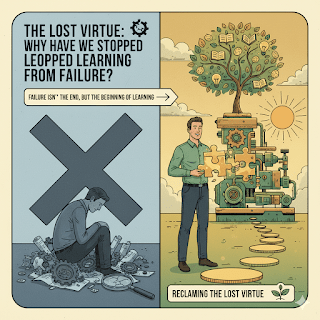
The Lost Virtue: Why Have We Stopped Learning from Failure?

Introduction: Failure Isn’t the End, But the Beginning of Learning

Imagine a child learning to walk for the first time. How many times do they fall? Dozens of times, yet we never label them a “failure.” Instead, we cheer them on, recognizing every stumble as a step toward mastering a new skill.
Yet, as adults, our unsuccessful experiences in life and work become stigmatized as “failures.” How did this concept transform from a natural part of learning into an obstacle we fear?
We live in an era that glorifies rapid success and instant results. However, the truth remains that failure is the most honest teacher in our journey—if we know how to benefit from its lessons.

The Roots of Fear: Why Do We Avoid Failure?
To deeply understand our fear of failure, we must explore its main sources:
Outcome-Oriented Upbringing and Education
We grew up in educational systems that rewarded only correct answers,where mistakes meant losing marks, not opportunities to learn. This approach instilled in us a fear of experimentation and risk-taking.
The Influence of Social Media
We daily witness images of success and perfection on digital platforms,yet we rarely see the real stories behind these successes. This creates the illusion that success is easy and guaranteed, while reality is quite different.
Unsupportive Work Environments
In many organizations,the focus is solely on final results, without appreciating the value of effort, process, and learning from mistakes. This culture stifles creativity and initiative.

Failure as a Teacher: Transforming Fear into Understanding
Failure can become a genuine school for growth if we change our perspective:
Failure is an Experience, Not an Identity
There’s a vast difference between saying”I am a failure” and “This attempt didn’t work.” The first is self-judgment; the second is experience evaluation.
Inspiring Examples from Failure
Many great inventors and figures experienced numerous failures before achieving their successes.Each unsuccessful attempt was a necessary step in their journey.
Unexpected Benefits
Unsuccessful experiences build psychological resilience,enhance problem-solving skills, and provide us with practical insights that successful experiences alone cannot offer.

Practical Steps: How to Learn from Failure Intelligently
Step One: Pause and Reflect
Take time for calm and deep thinking.Avoid impulsiveness and adopt the perspective of an objective observer.
Step Two: Objective Analysis
Search for the real causes without focusing on blame.Use sequential questioning methodology to reach the root causes.
Step Three: Extract Lessons
Clearly identify the lessons learned.What can be applied in the future? What changes are needed?
Step Four: Practical Application
Develop a new plan incorporating the lessons learned,then try again in a more effective manner.

Conclusion: Reclaiming the Lost Virtue
Failure isn’t an enemy to avoid, but a guide that can lead us to growth and development. When we treat it as a learning opportunity rather than the end of an attempt, we free ourselves from fear and move toward our goals with greater confidence.
Reflect on your most recent experience: What lessons did you learn? What changes did you make? Share your experience to inspire others.
Remember that true success isn’t about never falling, but about benefiting from every experience to reach a better version of yourself.
✍🏻 Written by Anas