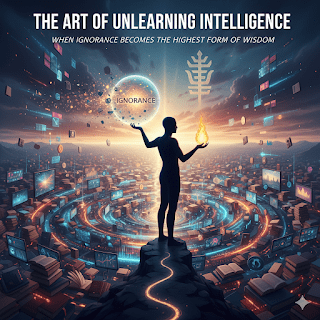
The Art of Unlearning Intelligence: When Ignorance Becomes the Highest Form of Wisdom

In the information age, where data pours in from every direction, we suffer from the modern epidemic: analysis paralysis. We often assume that intelligence means gathering all possible information, but true wisdom sometimes lies in deliberately letting go of knowledge.

1. Analysis Paralysis: When Intelligence Turns Against You
What is analysis paralysis?
It’s a state of mental freeze that occurs when:
· You’re faced with too many options
· You’re overwhelmed with massive amounts of data
· You’re afraid of making the wrong choice
Why does it happen?
The human brain is designed to process only a limited amount of information. When the input exceeds that capacity, it enters a state of “freeze” as a defense mechanism.
> Psychologists call this Decision Fatigue—when too many choices and too much information drain our mental energy and reduce the quality of our decisions.
A real-world example:
Someone wants to invest their savings:
· Reads 10 investment books
· Follows 20 financial experts
· Analyzes 50 companies
· Result: takes no action at all, out of fear of making a mistake

2. Deliberate Ignorance: The Highest Level of Practical Wisdom
Why is ignoring smart?
Because in today’s world, the scarcest resources are:
· Attention ⭐
· Mental energy ⭐
· Time ⭐
The 90/10 rule of knowledge:
90% of the information available is unnecessary for making the right decision. True intelligence lies in identifying the 10% that actually matters.
Types of smart ignorance:
· Ignoring non-expert opinions
· Ignoring information that can’t be applied
· Ignoring uncertain predictions about the future
· Ignoring generic “success tips” that don’t fit your context

3. Successful Decisions Built on Intuition
Fascinating examples:
1. Steve Jobs and the iPhone:
· Ignored market research claiming people wouldn’t want phones without buttons
· Trusted his intuition that users would adapt to touchscreens
· Result: a revolution in the smartphone industry
2. Marie Curie and Radium:
· Ignored the voices that dismissed research into radioactive materials as pointless
· Trusted her intuition about the field’s potential
· True, it came with a heavy personal health cost, but it opened the door to groundbreaking discoveries and two Nobel Prizes
3. A modern-day story:
A friend of mine started a small specialty coffee business. Instead of reading 50 market studies, he focused on three reliable sources, then relied on intuition and direct feedback from customers. Within a year, his income tripled.

4. How to Practice the “Art of Ignoring” in Daily Life
Practical steps:
1. Identify what to ignore:
· Information that can’t be acted upon
· Opinions from non-experts
· Speculative forecasts and uncertain predictions
2. Strengthen your intuition:
· Take time for silence and reflection daily
· Make quick decisions in small matters
· Learn from mistakes instead of fearing them
3. Apply the “Two-Minute Rule”:
If a decision won’t matter two years from now, take it in two minutes and move on.

5. Striking the Right Balance: When Is Knowledge Essential?
This is not about ignorance—it’s about selective intelligence.
Ignore Don’t Ignore
Non-expert opinions Advice from trusted professionals
Non-actionable information Actionable data
Speculative forecasts Lessons from the past
Noise of public opinion Your real needs
But beware:
Ignoring becomes avoidance when you dismiss essential truths—like medical advice or basic market realities. Wisdom is not apathy; it’s strategic selectivity.

6. Conclusion: True Intelligence Is Knowing What to Ignore
Wisdom is not about collecting all information—it’s about:
· Selective knowledge ✅
· Courage to ignore ✅
· Trust in intuition reinforced by experience ✅
Final thought:
In a world screaming w
ith information, silence has become intelligence.
Remember: Intelligence may help you know more, but wisdom helps you choose less.
What do you think? Have you ever tried ignoring a lot of information to make a better decision? 🤔
✍🏻 Written by Anas