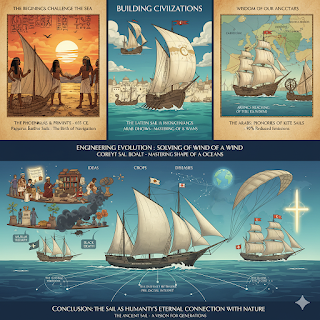
Sailboats: The Internet of the Pre-Digital Age
> “When humankind first raised a sail, it wasn’t merely to cross the water — it was to cross destiny itself. From the papyrus vessels of the Pharaohs to the mighty ships that span today’s oceans, this simple invention forever changed the world.”
1. The Beginnings: When Humanity Challenged the Sea with the Power of Wind

In ancient times, humans stood at the shores gazing toward the horizon, their questions too vast to be contained by land. Along the great Nile River, the ancient Egyptians built the first reed boats, followed by primitive sails made of woven mats and leather.
That moment marked a turning point in human history — the instant when people shifted from being mere riders of waves to their masters.
The invention of the sail was not purely an engineering feat; it was a reflection of human wisdom and intuition. How could a civilization realize that a simple piece of cloth could harness the wind and reshape the balance of power?
The leap from the oar to the sail was as revolutionary as the modern shift from steam engines to nuclear power.
2. Engineering Evolution: Solving the Mystery of Sailing Against the Wind

The Islamic civilization introduced a groundbreaking innovation — the lateen sail, a triangular design that revolutionized navigation.
For the first time, sailors were no longer slaves to the wind’s direction. They could “chase the wind” and sail at angles previously thought impossible.
Arab ships such as the dhow in the Arabian Gulf and the baghlah in the Indian Ocean became true masterpieces of naval engineering. Their resilience against storms and ability to carry vast loads made them rulers of the Indian Ocean for centuries.
3. Building Civilizations: Kingdoms Born from the Waves

The Phoenicians: Masters of the Mediterranean
More merchants and craftsmen than warriors, the Phoenicians built the first maritime trading empire in history. Their colonies stretched from Carthage in modern-day Tunisia to Cádiz in Spain.
They transported not only goods but also culture — spreading the alphabet that became the foundation of Mediterranean languages.
The Vikings: Shocking Europe and Reaching the New World
With their sleek and swift longships, the Vikings sailed up European rivers, striking deep into the continent.
Most astonishingly, archaeological evidence confirms that they reached America nearly 500 years before Columbus, rewriting the history of exploration.
The Arabs and Muslims: Pioneers of the Open Oceans
Navigators such as Ahmad ibn Mājid, known as The Lion of the Sea, led an era of discovery and knowledge.
Historical records suggest that Vasco da Gama used his navigational writings to reach India.
The Islamic trade network extended from the ports of China to the coasts of East Africa, carrying not only goods but also science, language, and philosophy.
4. The Great Exchange: What Did Sailboats Carry Besides Cargo?

The Spread of Diseases
Ships unintentionally became conduits for pandemics. The Black Death that wiped out a third of Europe’s population in the 14th century spread via maritime trade routes connecting Asia and Europe.
The Exchange of Crops
Coffee traveled from Yemen to the world, while sugarcane moved from India to the Islamic world and later to Europe and the Americas.
These exchanges didn’t just move commodities — they reshaped global agricultural systems.
The Exchange of Ideas
Sailboats were floating libraries, carrying philosophy and science across continents. They transported Greek heritage from Alexandria to Baghdad and later carried Islamic knowledge from Córdoba to Europe, fueling the Renaissance.
5. Naval Wars: When Victory Depended on the Shape of a Sail
The Battle of the Masts (655 CE):
The first major naval confrontation between the Islamic and Byzantine fleets. Despite their limited naval experience, the Muslims triumphed, proving their growing maritime prowess.
The Battle of Lepanto (1571 CE):
A historic clash between Islamic and Christian fleets — and between two sail designs. The victory of the Christian coalition marked a turning point in world naval power.
6. A Sustainable Legacy: Lessons from the Past for the Future
In an age of environmental crises and soaring fuel prices, engineers are once again turning to the wisdom of the sail for sustainable innovation.
Modern projects such as Sweden’s “Oceanbird” aim to build massive wind-powered cargo ships capable of reducing carbon emissions by up to 90%.
Other ventures use automated kite sails — giant airborne wings — to tow ships efficiently using natural wind power.
—
Conclusion: The Sail as Humanity’s Eternal Connection with Nature
Sailboats remind us that humanity’s greatest inventions are those that collaborate with nature, not fight against it.
Long before the telegraph or the Internet, sailboats served as the world’s original communication network — connecting peoples, ideas, and cultures.
In their humble design lies a timeless lesson: how to build a civilization that respects the environment and uses the Earth’s resources wisely.
Perhaps the answer to our modern sustainability challenges still flutters in
that ancient sail — carrying the wisdom of our ancestors and a vision for generations to come.
✍🏻 Written by Anas