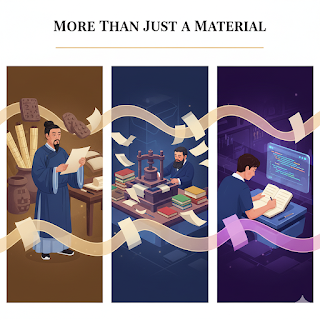
More Than Just a Material

Imagine a world without paper — no books, no currency, no artwork, no journals.
In our digital era, paper seems outdated, yet it remains vital in education, art, and daily life.
Paper is more than a tool; it’s a symbol of human memory, communication, and continuity.

Before Paper: Writing on Stone, Clay, and Skin
Before paper, civilizations used primitive materials to record knowledge.
In Mesopotamia, Sumerians inscribed laws on clay tablets.
In Ancient Egypt, papyrus scrolls documented royal decrees.
Greeks and Romans wrote on expensive animal parchment.
In China, texts were carved on bamboo or written on silk.
Each method was costly or fragile, limiting access to knowledge.

The Birth of Paper in China: A Knowledge Revolution
Around 105 CE, Cai Lun, a Chinese official, revolutionized writing by inventing paper from bark, rags, and fishing nets.
This simple yet ingenious method created a lightweight, affordable writing medium, democratizing knowledge and reshaping communication forever.

From the East to the Islamic World: Paper as a Bridge of Knowledge
The secret of papermaking reached the Islamic world after the Battle of Talas (751 CE).
Muslim innovators refined the process using linen fibers and water-powered mills, establishing paper mills in Baghdad, Damascus, and Andalusia.
Paper became the engine of the Islamic Golden Age, fueling the spread of science and philosophy from the House of Wisdom to the libraries of Europe.

Gutenberg and the Print Revolution
When Johannes Gutenberg invented the printing press in the 15th century, paper found its perfect partner.
Together, they sparked an information explosion, spreading books and ideas across Europe, paving the way for the Renaissance and Reformation.
Paper became the foundation of modern literacy and the global knowledge economy.

Why Paper Still Matters in the Digital Age
Despite digital transformation, we still rely on paper for learning, focus, and memory.
Scientific studies show that reading and writing on paper improve comprehension and retention.
Reasons paper endures:
🧠 Enhances memory and learning.
📖 Encourages deep focus without distractions.
💌 Offers a sensory, emotional experience.
📜 Ensures document reliability and authenticity.
⚡ Requires no power or connectivity.
Paper remains a timeless medium of trust and human connection.

Conclusion: A Bridge Between Past and Future
From Cai Lun’s invention to Gutenberg’s press to the AI era, paper tells the story of human progress.
The relationship between paper and technology isn’t competition — it’s coexistence.
Paper will continue to shape our world not just as a medium of information, but as a keeper of memory and culture.
✍🏻 Written by Anas