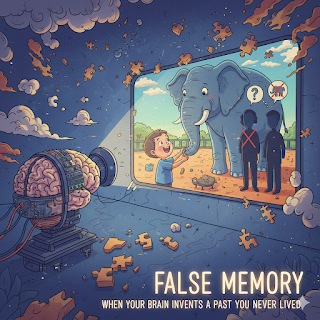
🧠 False Memory: When Your Brain Invents a Past You Never Lived

Have you ever vividly remembered a childhood trip — maybe feeding elephants at the zoo — only to have your parents insist that it never happened?
Welcome to the fascinating and unsettling world of false memory — one of psychology’s most mysterious phenomena.

What Is a False Memory?
A false memory occurs when someone remembers events that never actually happened, or recalls real events with distorted details.
The most astonishing part? These memories often feel completely real — detailed, emotional, and vivid — making it nearly impossible to tell truth from illusion.

How Does the Brain Create False Memories?
Your brain is not a video camera that records life accurately.
It’s more like a video editor — piecing together fragments, filling in gaps, and crafting a story that feels coherent.
Here are two ke
y psychological mechanisms behind false memories:
1. Constructive Recall
Every time you remember something, you’re not replaying a stored file — you’re rebuilding that memory from scratch.
During this process, the brain blends together past experiences, expectations, and even new information — leading to distortions.
2. The Misinformation Effect
When you’re exposed to incorrect information after an event (for example, a misleading question or secondhand story), your brain can unconsciously merge that misinformation into your original memory.
🧪 Famous Experiment:
Participants watched a short film of a car accident.
One group was asked, “How fast were the cars going when they hit each other?”
Another group was asked, “How fast were they going when they smashed into each other?”
Those who heard “smashed” estimated higher speeds — and many “remembered” broken glass that never existed!

Elizabeth Loftus and the Science of Implanted Memories
Psychologist Elizabeth Loftus revolutionized our understanding of memory with groundbreaking experiments that proved false memories can be planted.
🛒 The Lost-in-the-Mall Experiment:
About 25% of participants were led to believe that, as children, they got lost in a shopping mall and were rescued by a kind stranger — a completely fabricated story that felt real to them.
🐇 The Bunny Attack Study:
In another experiment, adults were convinced they’d been attacked by a giant cartoon rabbit named “Sergeant Bubbles” at a childhood birthday party!

How Are False Memories Created?
False memories can be implanted in many subtle ways, including:
1. Leading Questions:
Suggestive phrasing like “It was hot that day, wasn’t it?” can distort recall.
2. Guided Imagination:
Repeatedly imagining an event that never happened can eventually make it feel real.
3. Exposure to False Media:
Seeing doctored photos or fake stories can rewrite what we “remember.”
4. Suggestive Therapy:
Unethical hypnosis or “memory recovery” sessions can unintentionally create vivid but false memories of trauma.
Real-World Consequences of False Memory
False memories don’t just happen in labs — they shape real lives, relationships, and even justice systems.
⚖️ In Courtrooms:
Eyewitness testimony is often trusted, but memory distortion has led to wrongful convictions and miscarriages of justice.
🧠 In Psychotherapy:
The 1980s and 1990s saw a “recovered memory” scandal, where patients recalled supposed childhood abuse or satanic rituals — later proven to be false, implanted through suggestive therapy.
💬 In Everyday Life:
False memories can affect personal relationships — partners recalling completely different versions of the same argument, both utterly convinced they’re right.
—
How to Protect Yourself from False Memories
While there’s no foolproof “false memory detector,” awareness is your best defense. Here’s how to safeguard your mind:
1. Stay Humble About Memory:
Acknowledge that memory is fallible — even vivid recollections can be wrong.
2. Ask Neutral Questions:
Avoid suggestive phrasing when discussing past events.
3. Document Your Life:
Photos, journals, and videos can anchor real memories — though even images can be misleading.
—

Conclusion: Memory Is a Story, Not a Recording
False memory reminds us that human memory is not an objective record of the past — it’s a narrative our brain constructs to make sense of experience.
That fragility doesn’t make memory worthless; it makes it beautifully human.
In the
end, the haunting question remains:
> If some of our memories are illusions, what does that say about who we truly are?