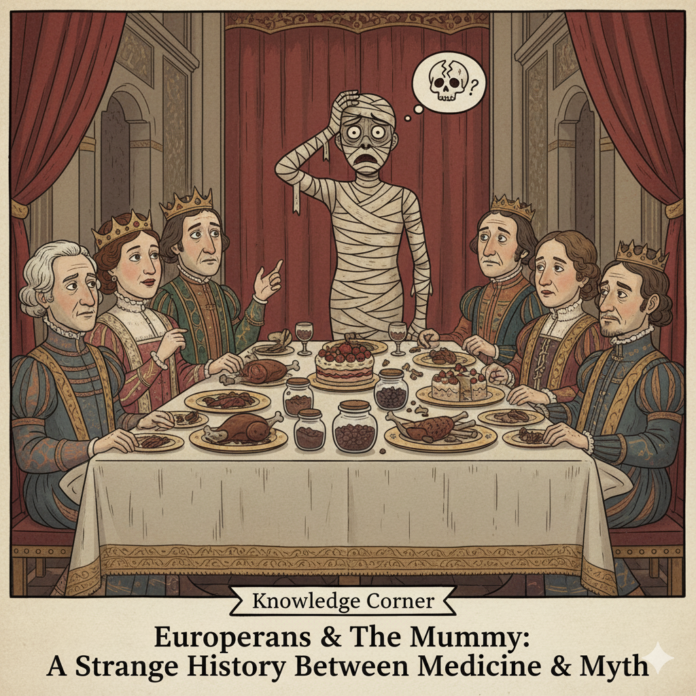

Europeans and the Mummy: A Strange History Between Medicine and Myth
Imagine, dear reader, that you’re invited to an elegant dinner in Europe five centuries ago and find on the table rice with mummy powder and cakes filled with crushed skulls! 😨 You might think I’m joking or describing a horror movie scene, but believe it or not… this actually happened across Europe for several centuries. What’s even more absurd is that people didn’t see it as strange — they treated it like a fashionable delicacy. Oh, the taste of refinement! 🍽️
—

The Beginning: One small mistranslation that flipped a continent
The story begins not with Europeans but with Arabs and Persians. There was a natural substance called mūmiyāʾ — a waxy, tar-like mix of bitumen, resins and oils — used medicinally for centuries. Great physicians like Avicenna and al-Razi mentioned it as a remedy for bruises and fractures.
Then an Italian translator, Gerard of Cremona, rendered Arabic medical texts into Latin and didn’t clearly distinguish between mūmiyāʾ (the medicinal substance) and mummy (the embalmed corpse). That tiny mistranslation is what ultimately led Europe to… literally eat the dead.
Trust me, dear reader — it was the simplest translation error in history… and it turned the deceased into “fast food”! 📜➡️🍲
—

Mummy as medicine: Europe, 12th–17th centuries
Quickly, the mummy became a “miracle cure.” Embalmed bodies were ground to powder and sold in apothecaries as a bitter brown dust. (And no — it didn’t taste like cocoa; imagine a mouthful of dust left after a sandstorm 🤢.)
They believed each part healed its corresponding part in the living body:
powdered skull = cure for headaches.
powdered skin = cure for skin diseases.
dried blood = cure for bleeding.
and for hemorrhoids… (honestly, dear reader, I’ll spare you the gruesome details — just thinking about it makes me staying uncomfortable rather 🤯).
This practice wasn’t only for peasants — courts and kings were into it:
Francis I of France apparently carried mummy powder with him wherever he went.
Charles II of England reportedly drank a tincture of mummy (alcohol mixed with ground mummy).
Even some royal physicians recommended it for plague and epilepsy!
Frankly, I don’t know whether they were treating sickness or just performing a ritual for their ailments! 👑🥄
—

Profitable — and fake — trade
As demand grew, Egyptian mummies ran low. A black market sprang up: recent corpses were wrapped and sold as “authentic” ancient mummies. Prices and “brands” emerged:
Vulgaris — the cheap common type.
Arabicus — the mid-range.
Sabulicorum — the luxury “designer” mummy for the wealthy.
Imagine choosing your mummy like you choose a phone model today!
“Do you want the Pro Mummy or the Standard?” 🤣
—

Mummy in art: from apothecary to canvas
Europeans didn’t stop at eating mummies — they painted with them. A pigment called Mummy Brown, made from ground mummy remains, was used for centuries in European paintings.
Funny enough, some artists stopped using it once they learned the source, while others shrugged: “So what? The brown is gorgeous.” 🎨
Picture admiring a beautiful painting — only to realize some of its brown shades are literally powdered human remains. Yikes!
—

Placebo: why people thought it worked
Strangely, some people felt better after taking mummy preparations. But the improvement wasn’t chemical; it was psychological — the placebo effect.
In simple terms: the brain believes the remedy will work, and the body responds as if it has. So Europeans were effectively healing themselves with… suggestion, flavored with mummy dust! 🧠✨
If we lived then, their prescription might read: “Take one spoonful before bed and your headache will vanish.” (And your dreams will be pharaonic nightmares!)
—

Dissenting voices… but quiet
Not everyone accepted this habit. Some clerics and philosophers denounced consuming human remains as a desecration of human dignity. But money, commerce and popular demand drowned out most objections.
Put plainly: whoever said “don’t eat the mummies” looked like the odd guest at a huge dinner party. 🍷🍖
—

The trend dies out: science speaks
By the 18th century, as medicine advanced, Europe recognized the practice as superstition. Apothecaries stopped selling mummy powder, and the phenomenon shifted from medicine to a subject of ridicule.
Yet obsession with Egyptian relics resurfaced — post-Napoleon — but now as antiquarian mania: people wanted mummies as curiosities, not as dinner ingredients.
In short: they moved from “eat the mummy” to “pose for a selfie with the mummy.” 📸
—

What did some writers say about this matter?
The English writer Jole Sylvain quipped wryly:
> “Sometimes I can’t wait for some sweet child to ask me: ‘Why are there so few mummies left?’ I’ll look him in the eye and say: ‘Because we literally ate them.’”
I love picturing the scene: the child’s eyes widen, and you try not to burst out laughing as you add, “Don’t worry — we won’t put Grandma on the menu.” 😂
—

Am I worried? (Just joking)
Honestly, the deeper I dig into this story, the more uneasy I get. What if, a thousand years from now, someone digs up my grave, wraps me in cheap linen, grinds me into powder, and sells me at the market as “authentic mummy supplement”? 😨
Just thinking about it makes me firmly repeat my final wish: Please — when I die, do not sell me as a dietary supplement!
—
Conclusion
The tale of Europeans eating mummies shows that even advanced societies can fall prey to error and superstition. It’s a lesson about the power of belief, and about how a tiny translation mistake can change the behavior of an entire continent.
The ancient Egyptian who tried to preserve his body for eternity could never have imagined ending up as powdered condiments on European tables. History, dear reader, keeps proving that truth is stranger than fiction.
✍️ Written by: Knowledge Corner