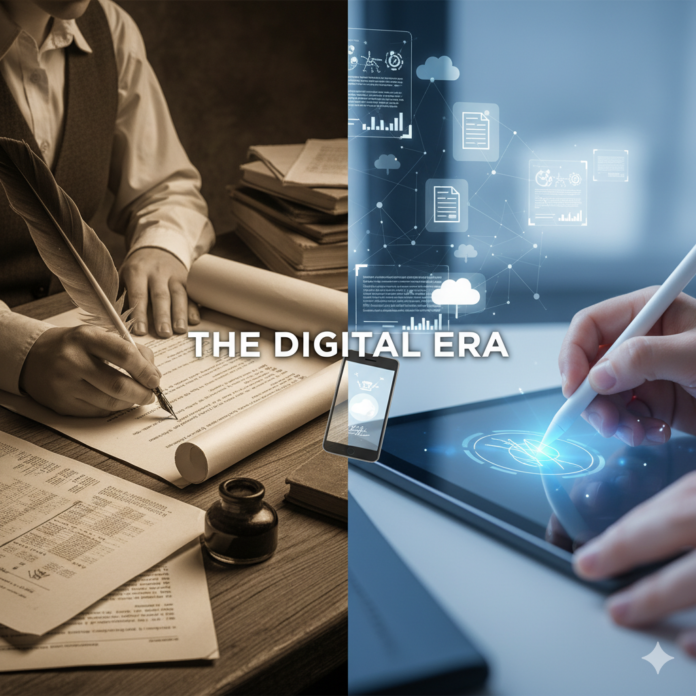

Electronic Signature: From Ink to Encryption
—
Introduction: When Ink Was No Longer Enough
In our previous article on the handwritten signature, we explained how it evolved from just a scribble on paper into an identity that could hardly be imitated. But let me ask you a personal question: how many times have you signed a paper without even reading it? A lease contract, an invoice, or even an exam sheet? 🤔
Today, the pen is no longer the ruler of the game. We now sign contracts, loans, and academic documents… all with the click of a button, without leaving home. This is called the electronic signature, which carried us from the age of ink to the world of encryption. It saves time, reduces crowds in schools, government offices, and companies, and even helps indirectly ease traffic jams.
—

A True Story: How One Electronic Signature Brought Down an Entire Company
Once, I heard a story about a mid-sized European company that fell victim to a strange kind of fraud. An official contract was sent by email and signed by one of the employees using his regular electronic signature (just an image of his handwritten signature). Later, they discovered the contract had been modified after signing, and a huge amount of money was stolen from the company.
But during the investigation, the company couldn’t prove the tampering, because the “signature” was not a digital encrypted signature—it was just an image that could be copied and pasted.
This incident became a harsh lesson: not every electronic signature is secure. You may sign a contract, but can you guarantee that it will stay the same after your signature? This pushed governments and companies to take maximum security measures, because such loopholes could cause chaos and endless legal problems.
So fasten your seatbelt, dear reader—today we’re diving into these questions, and we won’t let you go until your curiosity is fully satisfied.
—

The Difference Between an Electronic Signature and a Digital Signature
🔹 Electronic Signature (E-Signature):
Any electronic method of proving identity (an image, a fingerprint, signing with a stylus on a screen).
Easy to use, but mostly relies on trust between the parties.
Example: signing on a delivery device when you receive a package.
🔹 Digital Signature:
A special type of electronic signature based on encryption (Public Key Infrastructure – PKI).
Guarantees that the document has not been altered after signing.
Recognized worldwide in courts and official transactions.
Example: signing an international employment contract via platforms like DocuSign or Adobe Sign.
👉 In short: every digital signature is an electronic signature, but not every electronic signature is digital!
—

The Human Side: What Does This Mean for You and Me?
For the student: No more asking your father to come to school to sign your grades — an electronic signature will do (bad news you can’t forge it anymore, so study well to avoid trouble 😅).
For the homemaker: She can sign a property contract or even shop for essentials without leaving the house.
For the businessman: He can close million-dollar deals while waiting for his flight at the airport. This saves time and makes his career smoother.
Here, the signature is no longer “just a name written down.” It has become a bridge of trust in a fast, interconnected world.
—

How to Keep Your Digital Signature Safe?
1. Use trusted and well-known platforms to ensure the authenticity of your transactions.
2. Never share your private key or password with anyone (even close relatives — negligence costs a lot. Once, I personally sent my signature to someone, and they mistakenly forwarded it to another person. Long story ).
3. Always check the digital signature certificate (if a transaction lacks one, reject it).
4. Keep backup copies of your most important signed contracts (sometimes careless deletion of important files can cost you dearly).
—
Thinking About the Future of Signatures
Do you think, dear reader, that we may see new types of “signatures” in the future, such as iris scans? Some companies already use them. Personally, I use an eye scan in some places I go—it’s enough to confirm that I am the person in question, not someone else. Unlike facial features or voice, which can be similar or change over time, my iris feels far more secure.
Maybe one day we’ll even see tongue prints (since papillae patterns are unique), or signatures based on brainwave patterns, voiceprints, or facial recognition.
—
Conclusion: Your Signature Is You
From clay seals in ancient civilizations, to Shakespeare’s autograph, to today’s cryptographic keys, the goal has always been the same: to prove that it is really you standing behind the word or the contract.
The next time you press the “Sign” button, remember: you are not just confirming a transaction — you are writing a new line in humanity’s long journey with identity, honesty, and trust.
✍️ Written by: Knowledge Corner