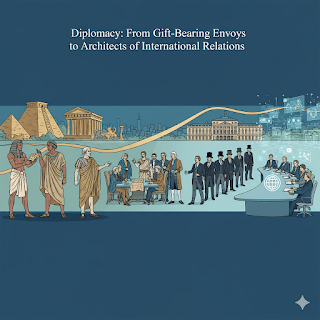
Diplomacy: From Gift-Bearing Envoys to Architects of International Relations

Introduction

Amid humanity’s endless conflicts, a refined art emerged as the civilized alternative to war and destruction: diplomacy. Diplomacy is not merely lavish receptions in embassies or hollow political speeches; it is the lifeline of relations among nations, and the most effective means of resolving disputes without bloodshed.
But when did humankind first realize the need to send envoys to adversaries? How did these emissaries evolve from messengers carrying gifts or threats into professional diplomats dressed in tailored suits, negotiating with briefcases full of documents?

The Origins of Diplomacy in Ancient Civilizations
In Mesopotamia and Ancient Egypt, the Amarna Letters (14th century BCE) represent the earliest known diplomatic archives. These clay tablets contained correspondence between Pharaohs and neighboring kings, covering marriage alliances, exchange of luxury gifts, trade negotiations, and even threats couched in polite language.
In the Arabian Peninsula, Islam introduced an early diplomatic model. The Constitution of Medina, drafted by Prophet Muhammad ﷺ, regulated relations among Muslims, Jews, and others, establishing principles of coexistence. His letters to rulers such as Heraclius of Byzantium and Muqawqis of Egypt were acts of diplomacy built on respect and persuasion.
In this era, there were no “professional diplomats.” Instead, envoys were esteemed figures—chieftains, leaders, or wise men—entrusted with missions to seal treaties, avert wars, or request assistance.

Greece and Rome: Structuring the Profession
In Ancient Greece, the “Proxenos” system was established, resembling the modern honorary consul.
The Romans, with their organizational genius, introduced early notions of diplomatic immunity, declaring envoys sacred figures whose harm equated to a declaration of war. This protection was crucial for enabling diplomacy to function effectively.

The Renaissance: Birth of the Resident Ambassador in Italy
With the rise of the nation-state, Italian city-states such as Florence, Milan, and Venice—locked in constant rivalry—recognized the need for permanent representation. Thus emerged the resident ambassador, no longer dispatched for temporary missions but stationed long-term in foreign capitals. Their role expanded to include intelligence gathering, relationship-building, and continuous negotiation. Here, diplomacy became a professionalized craft with recognized codes and etiquette.

From Westphalia to the Congress of Vienna: Building a Diplomatic System
The Peace of Westphalia (1648) ended the Thirty Years’ War and enshrined the principle of state sovereignty, making diplomacy the exclusive channel of interstate relations.
The Congress of Vienna (1815), held after the Napoleonic Wars, finalized the framework of modern diplomacy. It standardized diplomatic ranks (Ambassador, Minister Plenipotentiary, Chargé d’Affaires) and resolved protocol disputes, ensuring uniformity across capitals.

Modern Diplomacy: Challenges and New Trends
The 20th and 21st centuries transformed diplomacy dramatically:
The United Nations institutionalized multilateral diplomacy, bringing dozens of states together under one roof to address global issues such as security, climate, trade, and health.
The scope of diplomacy expanded beyond politics to include economic, environmental, health, and humanitarian diplomacy. Examples include the Paris Climate Agreement (2015) and international coordination during the COVID-19 pandemic.
The information revolution gave rise to digital diplomacy. Governments now use social media to engage directly with foreign publics, while diplomats focus on analyzing vast streams of data to provide accurate recommendations to decision-makers.

Conclusion
From clay tablets exchanged between ancient kingdoms to Twitter feeds managed from embassies, and from Pharaohs’ letters to climate agreements, diplomacy proves to be more than a profession—it is a human necessity. It builds bridges between diverse peoples and serves as a safeguard against global crises.
The pressing question remains:
> Will the future rely more on traditional ambassadors operating behind closed doors,
or on digital diplomats shaping dialogue in the global public sphere?
✍🏻 Written by Anas