
Useful Summary
People are not naturally more aggressive online. Social media platforms, group dynamics, and anonymity all contribute to this behavior. Algorithms reward emotional content, echo chambers reinforce beliefs, and the lack of accountability makes people more willing to act aggressively. Together, these factors create an environment where conflict spreads easily and often gets more attention than respectful discussion.
Why Does Social Media Feel So Hostile?
If you compare real life with online behavior, the difference is clear.
In real life:
- People avoid unnecessary conflict
- They think before speaking
- They consider consequences
Online, this restraint often disappears.
Small disagreements quickly turn into arguments.
And arguments often turn into personal attacks.
This is not random. It is influenced by how platforms are designed.
Algorithms Reward Emotional Reactions
Most social media platforms are designed to maximize engagement.
Platforms like Facebook promote content that generates reactions, regardless of whether those reactions are positive or negative.
This creates a pattern:
- Calm content gets ignored
- Emotional content spreads
- Controversial content performs best
Research from the Pew Research Center shows that posts expressing anger or outrage tend to receive higher engagement.
As a result, users are indirectly encouraged to post more emotional and sometimes aggressive content.
Echo Chambers Reduce Tolerance

Social media platforms personalize what you see.
You are more likely to be shown:
- Content you agree with
- People who share your views
- Opinions similar to yours
Over time, this creates what is known as an echo chamber.
When you rarely encounter opposing viewpoints, you may start to believe your opinion is the only correct one.
So when someone disagrees, it feels more like a personal attack than a normal discussion.
Psychotherapist Aaron Balick explains that emotions like anger spread quickly within groups, especially when people reinforce each other’s beliefs.
Anonymity and Lack of Accountability
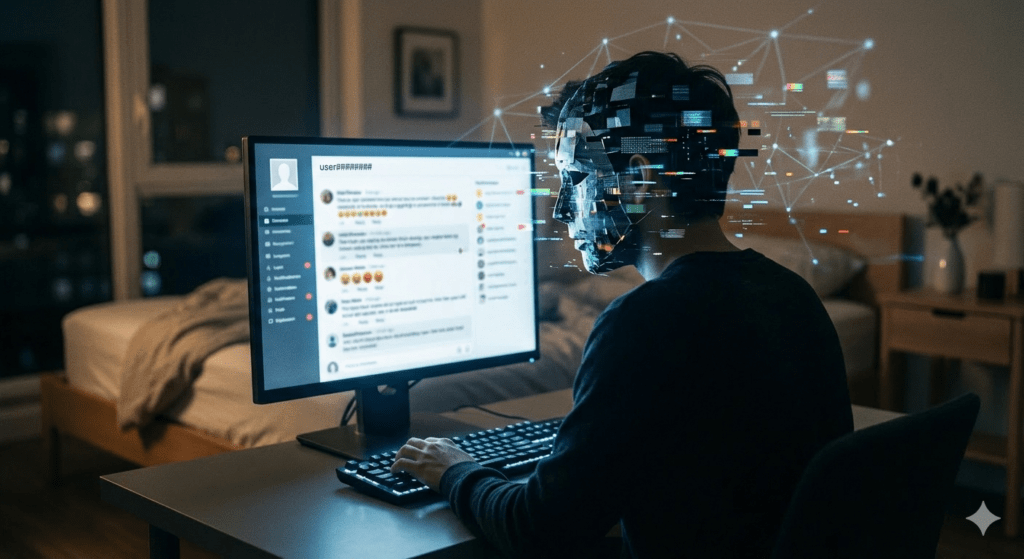
In offline life, social identity plays a major role in behavior.
Online, that identity is often reduced or hidden.
A well-known experiment by Philip Zimbardo showed that people are more likely to behave aggressively when they feel anonymous.
On the internet, this is common:
- Users can hide behind usernames
- There are fewer immediate consequences
- Social pressure is weaker
This makes it easier for people to say things they would not say in real life.
The Role of Dopamine and Habit Formation
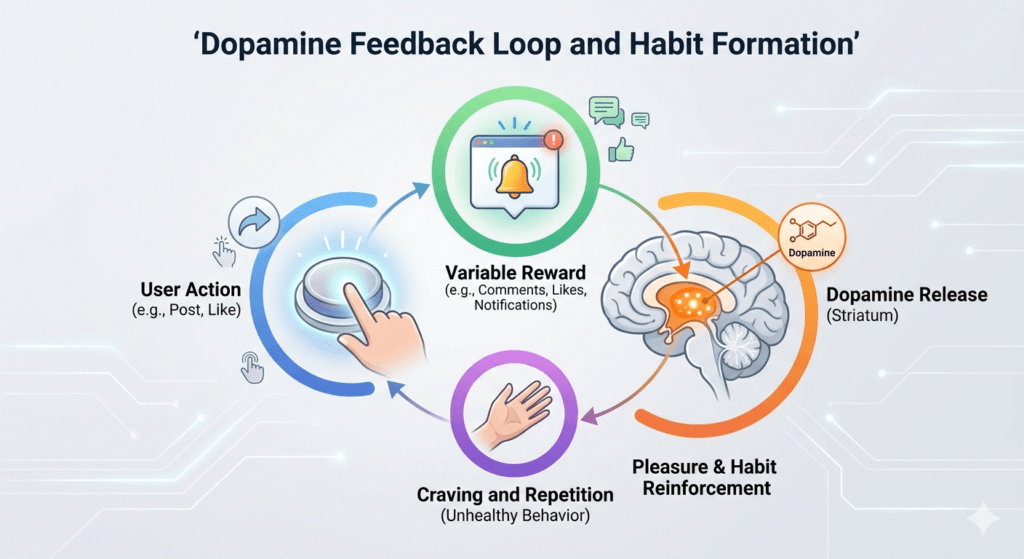
Social media interactions trigger dopamine release in the brain.
This creates a feedback loop:
- You post something
- You receive reactions
- You feel rewarded
- You repeat the behavior
Over time, users may shift toward more emotional or extreme content because it generates stronger reactions.
This is how engagement can slowly turn into habit and sometimes into unhealthy behavior.
What Does This Mean for Users?
Understanding these factors can help you use social media more consciously.
Practical steps:
- Avoid engaging in unnecessary arguments
- Do not reward toxic content with attention
- Be aware of how algorithms influence what you see
- Take breaks from highly emotional discussions
Small changes in behavior can reduce exposure to negativity.
A Broader Perspective
Aggressive behavior in groups is not new.
Historically:
- People behaved more boldly in crowds
- Individuals felt less responsible in groups
However, social media amplifies this effect by:
- Increasing speed of interaction
- Expanding audience size
- Reducing personal accountability
This combination makes online environments more intense than traditional social settings.
Conclusion
Online aggression is not simply a personal issue. It is shaped by technology, psychology, and social dynamics.
By understanding how these systems work, users can make better decisions and avoid being drawn into unnecessary conflict.
The goal is not to stop using social media, but to use it with awareness and control.
FAQ
People are not necessarily more aggressive by nature. Online environments, including algorithms, anonymity, and echo chambers, encourage more aggressive behavior by amplifying emotional and controversial content.
Because online discussions lack social cues, are faster, and are visible to a large audience, which increases intensity and emotional reactions.
Yes. Constant exposure to negative interactions can increase stress, anxiety, and emotional fatigue, especially with excessive use.
In most cases, no. Responding to negative content increases its visibility and encourages further engagement.