Useful Summary
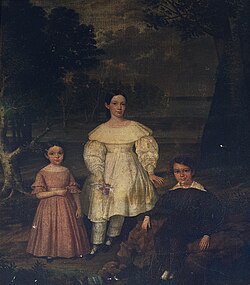
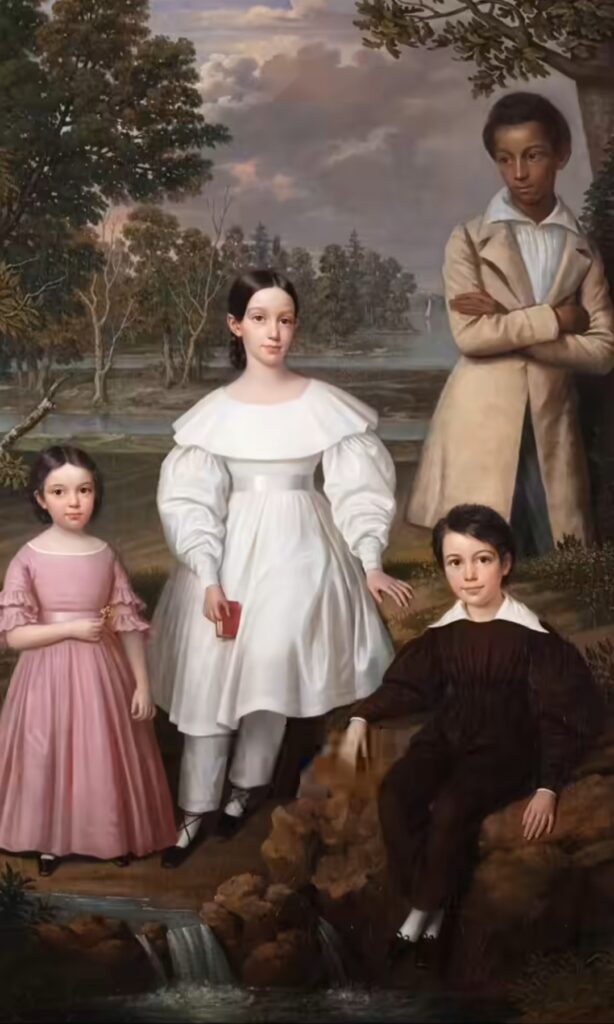
In a remarkable historical discovery, modern restoration work revealed a hidden figure in an 1837 painting by Jacques Amans in New Orleans, Louisiana. For decades, the artwork was believed to show only the children of the Frey family. However, scientific restoration uncovered that the original painting also included an enslaved Black teenager named Bélizaire, whose image had been deliberately painted over. After restoration, the artwork regained its original title: “Bélizaire and the Frey Children.”
The Full Story: A Boy Who Was There… Then Disappeared
In 1837, artist Jacques Amans painted a group portrait of the Frey family children, a white family living in New Orleans, Louisiana.
The painting shows three children standing near a small stream in a calm natural setting. Behind them stands a dark-skinned boy, about 15 years old, named Bélizaire.
Bélizaire was:
- An enslaved boy living in the same household as the Frey family.
- Responsible for accompanying and helping care for the children.
- A daily presence in their lives in the historic French Quarter district.
What makes the painting striking is the way Amans portrayed him:
- Wearing neat clothing similar to the children’s attire.
- Standing upright with a confident posture.
- Appearing as part of the family scene rather than merely a servant in the background.
Yet decades later—possibly in the late twentieth century—someone who owned the painting covered Bélizaire’s image with a layer of paint, leaving the artwork to appear as if it depicted only the Frey children.
How Bélizaire Returned to the Painting
With the development of modern restoration technology, the artwork was analyzed using advanced scientific techniques such as:
- Infrared imaging
- Spectral analysis
- Examination of paint layers
During restoration, experts made a surprising discovery: a complete hidden figure beneath the later paint layer.
After carefully removing the added paint, Bélizaire reappeared exactly as the artist had originally painted him nearly two centuries earlier.
- The painting has been renamed to include his name.
- Researchers began studying his life and historical context.
- The artwork is now considered an important document of American social history during slavery.
What Does This Discovery Mean for the Public?
The return of Bélizaire to the painting is not only an artistic story—it carries deeper meaning about memory, history, and identity.
- Rewriting visual history: Paintings are social documents reflecting their time.
- Revealing historical erasure: Painting over Bélizaire suggests an attempt to hide part of the past.
- Restoring marginalized voices: His reappearance recognizes enslaved individuals’ presence in daily life.
- Changing how we read art: The portrait is now seen as a complex social snapshot.
A Historical Perspective
The story of Bélizaire is unusual, but not entirely unique. Throughout art history, paintings have been altered to remove unwanted figures, erase political symbols, or adjust appearances to fit social expectations.
This case is especially important because it relates to the era of slavery in the United States, which lasted until the American Civil War (1861–1865), after which slavery was abolished.
For historians, Bélizaire’s restored presence offers a rare visual insight into everyday relationships within slave-holding households.
The Mystery of Bélizaire: What Happened to Him?
Much about Bélizaire’s life after the painting remains unknown. Historical records suggest he was enslaved by the Frey family, lived closely with the children, and may later have been sold when the family faced financial difficulties.
This adds a tragic dimension to the story: the boy who stood confidently in the painting may eventually have been separated from the family he lived with.
Conclusion: History Is Never Truly Lost
The story of Bélizaire reminds us that history is not fixed. Sometimes parts of it are hidden, forgotten, or intentionally erased—but with time, research, and technology, they can reemerge.
Today the painting is more than a 19th-century portrait. It has become a symbol that people once erased from history can eventually reclaim their place in humanity’s collective memory.
And perhaps the most intriguing question remains: how many other hidden stories are still waiting beneath the layers of paint in museums around the world?